The Psychology of Search: What Customers Are Really Thinking When They Find You Online
Your customers are searching for you right now. But what’s really going through their minds when they type those words into a search bar?
Understanding the psychology behind search behavior is the difference between getting found and getting ignored. When you know what your customers are thinking, you can create content that speaks directly to their needs, fears, and desires.
Let’s dive into the mind of your ideal customer and uncover what they’re really looking for.
The Four Stages of Search Psychology
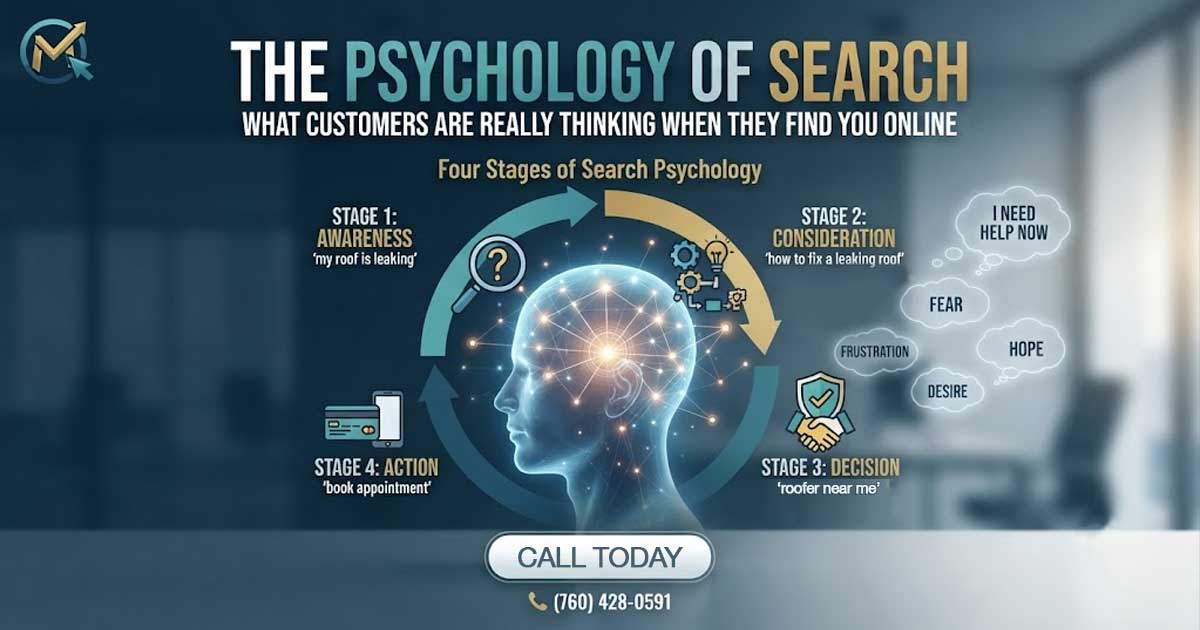
Every search follows a predictable psychological journey. Understanding these stages helps you create content that meets customers where they are.
Stage 1: Awareness
Your customer has a problem. They know something isn’t right, but they’re not sure what to do about it. They type general phrases like “my roof is leaking” or “I need more customers.”
Stage 2: Consideration
They’ve identified their problem and are now researching solutions. They type more specific phrases like “how to fix a leaking roof” or “best marketing for small business.”
Stage 3: Decision
They’ve narrowed down their options and are ready to choose. They type branded terms like “Markinate reviews” or “plumber near me call now.”
Stage 4: Action
They’re ready to buy, call, or visit. They type transactional phrases like “book appointment,” “buy now,” or “get a quote.”
Why this matters: Most businesses create content that only serves Stage 3 and 4. They skip the awareness and consideration stages entirely. But that’s where trust is built. That’s where you establish authority. And that’s where you win customers before they even know your competitors exist.
What Customers Really Want When They Search
Here’s what’s going through your customer’s mind when they search for your products or services:
“I need help, and I need it now.”
Customers search when they have an immediate need. They’re not browsing—they’re buying. Your content needs to offer solutions, not just information.
“Can I trust this business?”
Trust is the #1 factor in purchase decisions. Customers are looking for proof: reviews, testimonials, case studies, and evidence that you deliver.
“What makes them different?”
Customers want to know why they should choose you over competitors. Your content needs to highlight your unique value clearly and convincingly.
“What’s the next step?”
Once a customer is ready to act, they need clear direction. Your content must tell them exactly what to do next—call, email, or visit.
“Will this solve my problem?”
At the end of the day, customers want results. Your content needs to demonstrate how you solve their specific problem.
Learn how our Ad Rotation System addresses every stage of the customer journey.
The Role of Emotion in Search
People don’t search rationally. They search emotionally. Here’s how emotions drive search behavior:
Fear
“I’m losing money.” “I’m falling behind.” “I’m missing opportunities.” Fear-based searches are often urgent. Customers need immediate reassurance that you can help.
Frustration
“Nothing is working.” “I’ve tried everything.” Frustration drives customers to search for “easy” or “proven” solutions.
Hope
“There must be a better way.” Customers search for hope—for a solution that finally works. Your content needs to be that hope.
Trust
“Is this business legit?” “Can I believe what they say?” Trust-based searches look for proof: reviews, credentials, and real results.
Desire
“I want to be successful.” “I want to be happy.” “I want to be the best.” Desire-based searches are aspirational. Customers want to feel like the solution will make their life better.
Address these emotions with search-optimized content that connects on a human level.
How to Create Content That Connects
Now that you understand search psychology, here’s how to create content that resonates:
1. Speak their language.
Use the same words your customers use. Don’t use industry jargon. Talk like a human, not a textbook.
2. Answer the question before it’s asked.
Anticipate what your customers are wondering. Address their concerns, objections, and fears in your content.
3. Show, don’t just tell.
Demonstrate your expertise with examples, case studies, and real results. Show proof that you deliver.
4. Provide clear next steps.
Every piece of content should tell the customer what to do next. Make it obvious and easy.
5. Be consistent.
Trust builds over time. Consistently showing up with helpful content establishes authority and reliability.
The Trust Gap: Why Customers Don’t Contact You
Here’s a hard truth: If customers aren’t contacting you, it’s often because they don’t trust you yet. Here’s why:
They can’t find you. You’re invisible in search. They look for you and don’t see you. Trust starts with visibility.
They can’t verify you. Your Google Business Profile is incomplete. You have few or no reviews. They can’t confirm you’re legitimate.
They don’t see proof. You talk about what you offer, but you don’t show results. Trust requires evidence.
They don’t know who you are. Your business feels faceless and impersonal. People buy from people. Show your human side.
They don’t feel a connection. Your content feels generic and disconnected. It doesn’t speak to their specific needs or emotions.
See real client results that build trust and credibility.
How We Build Trust Through Search
Our system is designed to address every stage of search psychology:
We make you visible. Daily posts on 6 platforms ensure you show up when customers search.
We build credibility. Consistent, high-quality content establishes authority and expertise.
We guide action. Every post includes a clear next step—call, visit, or learn more.
View our packages to see how we build trust and drive results.
Common Search Psychology Mistakes
Mistake #1: Focusing only on the decision stage.
You skip awareness and consideration entirely. Customers don’t trust you because they don’t know you.
Mistake #2: Talking about yourself, not your customer.
Your content is about your business, not your customer’s problems. Customers don’t care about you—they care about solutions.
Mistake #3: Being generic.
Your content sounds like every other business. No differentiation. No personality. No connection.
Mistake #4: Forgetting emotion.
You focus on facts and features, not feelings and benefits. Customers buy emotionally and justify rationally.
Mistake #5: No clear action.
Your content informs but doesn’t direct. Customers don’t know what to do next.
The Bottom Line
Understanding search psychology changes everything. When you know what your customers are thinking, feeling, and needing, you can create content that truly connects.
Stop guessing. Start understanding. And watch your customers find you.
Ready to understand your customers better?
Call us at (760) 428-0591
Or Claim Your Free Samples to see how we create content that connects.